Be Good & Do Good!

Year: 2010 (Page 7 of 8)

Google Chrome now has extensions and bookmark sync

chrome_logo_may09.jpgGoogle just released a new stable version of Chrome for Windows PCs that includes two of the most frequently requested features: extensions and bookmark sync.

This change won’t affect those users who are already using these features through Chrome’s beta or developer preview channel. Windows users who are using the stable version of Chrome, however, will finally be able to use extensions and sync bookmarks between multiple machines.

Google Plunges Into Social Networking – Google Buzz

Buzz URL : http://www.google.com/buzz

http://www.google.com/s2/static/images/1444417344-GoogleBuzzLogo68.png

Google and Facebook are on a collision course in the increasingly competitive market for social networking services.

On Tuesday, Google introduced a new service called Google Buzz, a way for users of its Gmail service to share updates, photos and videos. The service will compete with sites like Facebook and Twitter, which are capturing an increasing percentage of the time people spend online.

The links shared on those social networks are also sending a growing amount of traffic to sites across the Web, potentially weakening Google’s position as the prime navigation tool on the Internet.

Separately, Facebook plans to announce on Wednesday that it is improving the live chat service on its site by allowing it to be integrated into other services like AIM, AOL’s instant messaging network, which is among the most popular in the United States.

Buzz is Google’s boldest attempt to build a social network that can compete with Facebook and Twitter. The service is built into Gmail, which already has 176 million users, according to comScore, a market research company. And Buzz comes with a built-in circle of friends, a group that is automatically selected by Google based on the people that a user communicates with most frequently in Gmail and on Google’s chat service.
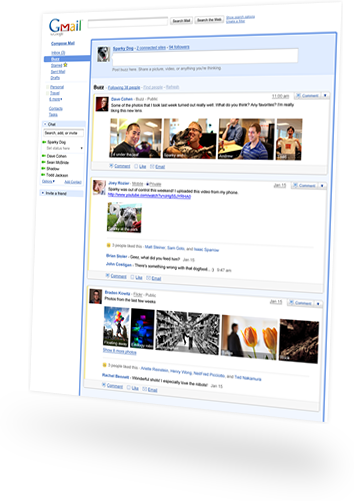
Google Buzz

Like other social services, Buzz allows users to post status updates that include text; photos from services like Google’s Picasa and Yahoo’s Flickr; videos from YouTube; and messages from Twitter. Analysts say many of its features mimic those of Facebook.

It is a direct challenge to Facebook, in particular,” said Jeremiah Owyang, a social media analyst with the Altimeter Group.

Still, Buzz faces a struggle against Facebook, which recently announced, on the occasion of its sixth birthday, that it had 400 million users. Buzz also risks further overwhelming people who are struggling with Web services that generate ever-increasing amounts of information.

But Google executives said that, on the contrary, Buzz would help tackle the problem of information overload, as Google would apply its algorithms to help people find the information most relevant to them.

The stream of messages has become a torrent,” Bradley Horowitz, vice president for product development at Google, said in an interview. “We think this has become a Google-scale problem.”

Sergey Brin, a Google co-founder, said that by offering social communications, which have primarily been used for entertainment purposes, Buzz would bridge the gap between work and leisure.

Bridging those two worlds is very powerful,” Mr. Brin said at a press conference, adding that he had used Buzz to help him write an Op-Ed article for The New York Times by soliciting input from other Google employees.

Google has also woven Buzz into mobile phones, through a mobile Web site and a Google mapping application. Users will be able to see updates that friends have posted from particular spots.

Read complete story @ http://www.nytimes.com/2010/02/10/technology/internet/10social.html

10 reasons why the iPad fails to impress

Here are 10 reasons on why ThinkDigit thinks the iPad sucks ..

No multitasking. Remember, it’s meant to be better than a netbook.
No Flash support. “The best web experience”; indeed
Screen is not widescreen. Well, innovation sometimes take us a few steps backwards
No HD output. Who watched HD these days anyway?
No camera. So much for video chat…
No USB port. Don’t want to be too much like a netbook now do we?
No SD card slot. Cause 64GB ought to be enough for anybody…
Essential peripherals sold extra: keyboard, USB, SD card dongles, each sold for $30!
Another iPhone-like operating system. Read closed system. This seems to be Apple’s game plan
You need to pay $10 per app for the iWork productinvity applications suite. It’s like Apple didn’t want you, or expect you to be productive on it by default

Slate Comparision : iPad vs. HP Slate vs. JooJoo vs. Android Tablet vs. …

Everybody’s talking about tablets, especially those single-pane capacitive touchscreen ones more specifically known as “slates.” The iPad is the biggest newsmaker, but there are lots headed our way (most with built-in webcams). Here’s how they measure up, spec-wise:

Slate Comaprision

The iPad has the most storage, cheap 3G, the time-tested iPhone OS and its mountain of apps, and a serious amount of Apple marketing juice behind it. But it’s also famously lacking features common to the other tablets, such as webcam and multitasking (only first party apps like music and email can multitask). The Notion Ink Adam is perhaps the most interesting of the bunch, with its dual-function transflective screen from Pixel Qi: It can be either a normal LCD or, with the flick of a switch, an easy-on-the-eyes reflective LCD that resembles e-ink. Its hardware is also surprisingly impressive—but it remains to be seen if Android is really the right OS for a 10-inch tablet.

Source : gizmodo.com

Salesforce – Using List Custom Settings

Salesforce.com recently introduced Custom Settings in Winter ‘10 which allows you to store custom data sets and associate them on an org-wide, profile or user basis. Custom Settings are essentially custom objects that are exposed in the applications cache and are accessible via their own API.

You can certainly build your own custom objects to store settings but using custom settings is much quicker (again they are stored in the application cache) and do not count against SOQL limits when fetched. You can also use custom settings in formula fields, validation rules, Apex code and the Web Services API.

Custom settings come in two flavors: list and hierarchy.

Jeff’s post focuses on list custom settings which is the simpler of the two to grok. Read Jeff post @ http://blog.jeffdouglas.com/2010/01/07/using-list-custom-settings-in-salesforce-com/

Google starts phasing out Old Browser support

Google in an email to all developers states following …

In order to continue to improve our products and deliver more sophisticated features and performance, we are harnessing some of the latest improvements in web browser technology. This includes faster JavaScript processing and new standards like HTML5. As a result, over the course of 2010, we will be phasing out support for Microsoft Internet Explorer 6.0 as well as other older browsers that are not supported by their own manufacturers.

We plan to begin phasing out support of these older browsers on the Google Docs suite and the Google Sites editor on March 1, 2010. After that point, certain functionality within these applications may have higher latency and may not work correctly in these older browsers. Later in 2010, we will start to phase out support for these browsers for Google Mail and Google Calendar.

Interesting facts about “Bombay STATE”

During British rule, portions of the western coast of India under direct British rule were part of the Bombay Presidency. In 1937, the Bombay Presidency became a province of British India.

After Indian independence in 1947, many former princely states, including the Gujarat states and the Deccan states, were merged with the former Bombay province, which was renamed the State of Bombay.

The State of Bombay was significantly enlarged on November 1, 1956, expanding eastward to incorporate the Marathi-speaking Marathwada region of Hyderabad State, the Marathi-speaking Vidarbha region of southern Madhya Pradesh, and Gujarati-speaking Saurashtra and Kutch. The southernmost, Kannada-speaking portion of the state became part of the new linguistic state of Karnataka. The state was being referred to by the local inhabitants as Maha Dwibhashi Rajya, literally, the great bilingual state.

The state was home to both Marathi and Gujarati linguistic movements, both seeking to create separate linguistic states. The Mahagujarat movement in Gujarat was led by Shri Indubhai Yagnik. On May 1, 1960, after a movement for a separate Marathi state turned violent, the State of Bombay was partitioned into the States of Gujarat and Maharashtra.

Learning Spanish … Learn Spanish …

I heard that Angels do exist in each part of world, but aren’t Teachers true Angels .. teaching kids in every part of world ….

Here comes Spanish words, I am learning from my Spanish teacher ..

Hola — Hello, hi
Adiós — Goodbye
Buenos días — Good day, good morning
Buenas tardes — Good afternoon, good evening
Buenas noches — Good night
Mucho gusto. Encantado. — It’s a pleasure to meet you.
Bienvenido, bienvenida, bienvenidos, bienvenidas — Welcome

Salesforce – Spring ’10 Release Preview Webinar

Spring’10 webinar covered a number of features to help you, whether you’re building new applications on Force.com, or using existing products such as Salesforce CRM.

Part 1 : Custom Cloud – Learn how many new Force.com features, including Multilevel Master-Detail Relationships and Rich Text Areas, can help you build richer applications, faster.

Part 2 : Sales & Service Cloud – Discover how new features in Salesforce CRM, including Salesforce Automation, Salesforce Knowledge and Salesforce Answers, can help transform the way you interact with customers and partners.

View the two recorded webinars at http://wiki.developerforce.com/index.php/Tech_Talk:_Spring10_Release_Preview

« Older posts Newer posts »